Irish Private Tours - Boyne Valley
The Boyne Valley, just north of Dublin, is one of Ireland’s most important and atmospheric destinations for a private day tour. This remarkable landscape was once the heart of ancient Ireland, and kingship, ritual and mythology still cling to it.
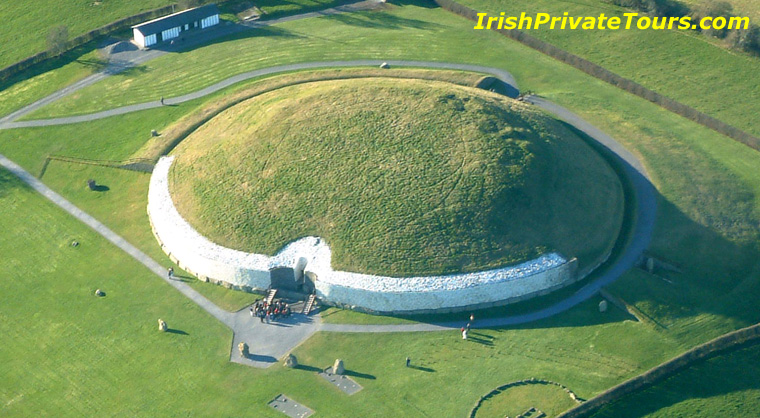 Newgrange 5,000 year old passage tomb in the Boyne Valley
A day tour explores the world renowned prehistoric monuments of Newgrange and Knowth, both set within the UNESCO World Heritage landscape of Brú na Bóinne. Neolithic builders raised these passage tombs over five thousand years ago, and they remain among the finest surviving monuments in prehistoric Europe.
The tour also takes in later chapters of Ireland’s story. At the Hill of Tara, the ceremonial seat of the High Kings, you can look out across a landscape shaped by power, belief and tradition. At Monasterboice, the tenth century high crosses and round tower show early Christian Ireland at its artistic peak.
Pricing
The tour costs €700 plus booking fees for up to 6 guests, charged per vehicle rather than per person. Admission fees are extra. Newgrange and Knowth need official OPW timed tickets. When they are on your itinerary, we purchase them on your behalf and add the admission cost to your booking. Meals are not included. The day can be extended beyond the standard 8 hours at an hourly rate.
Boyne Valley Day Tour
- Collection from your accommodation or cruise ship.
- Visit to the Brú na Bóinne Visitor Experience, providing context and background to the five thousand year old passage tombs of the Boyne Valley.
- Guided visit to the megalithic passage tombs at Newgrange and Knowth with official on site guides. Because these are UNESCO World Heritage Sites, visits take place as part of the official program.
- Hill of Slane , where St. Patrick is said to have lit the Paschal Fire in 433 AD.
- Hill of Tara , ceremonial seat of the High Kings of Ireland.
Tours can be customized. Other sites of interest in the Boyne Valley include:
- Dowth, a lesser known passage tomb that has not been restored and allows time for quiet reflection away from crowds.
- Fourknocks, an off the beaten track megalithic tomb offering insight into prehistoric burial practices.
- Monasterboice, an early Christian monastery with a round tower and some of Ireland’s finest high crosses.
- Mellifont Abbey, founded in 1142 and regarded as the birthplace of the Cistercian order in Ireland.
- Bective Abbey , a later Cistercian foundation set beside the River Boyne.
- Kells , known for its high crosses, round tower and association with the Book of Kells.
As this is a private day tour, we adapt the itinerary to suit your interests. Some guests prefer to focus on prehistoric sites such as Newgrange, Knowth and Dowth, while others enjoy a broader overview taking in early Christian and medieval Ireland.
Christian heritage runs deep in the Boyne Valley. Tradition links Saint Patrick with the Hill of Slane. Monasterboice and Kells then show early monastic settlement at its best, with high crosses and round towers. Mellifont Abbey, founded in 1142, brought the Cistercian way of life to Ireland. Bective Abbey followed shortly after as one of its daughter houses.
Many visitors choose to spend extra time at the Hill of Tara. From the early Celtic period until the Norman invasion, Tara served as Ireland’s political and symbolic center. Its kingship traditions combined authority, ritual and mythology, and many Kings of Tara also held the title of High King of Ireland.
A private tour also makes time for places beyond the main visitor routes. There the landscape feels quieter, and the past feels closer. Sites such as Fourknocks and Dowth are rarely busy, and they keep an authenticity that heavily managed monuments often lose. At these places the surroundings matter as much as the stones, and silence, light and weather all become part of the experience.
Fourknocks sits deep in the Meath countryside. You visit by arrangement, often in complete solitude. A grass covered roof shelters the chamber and keeps the interior carvings in remarkable condition. With no crowds, the atmosphere stays calm and reflective, and you meet a Neolithic tomb much as its builders intended.
Dowth presents a striking contrast. It stands high above the River Boyne, so the views stretch across the landscape, particularly in changing light. The mound remains largely unrestored, bearing the marks of early excavations and later history. Carved stones sit at the base of the mound and an ancient tree grows along the slopes, giving Dowth a raw, layered character.
A private tour also places the famous monuments in context. After the quieter, less restored sites, you grasp the scale of Knowth and Newgrange differently. Access to these UNESCO World Heritage Sites is closely managed by the Office of Public Works, yet seeing them within a wider landscape of ritual, burial and symbolism adds real depth to the visit.
No single monument defines the Boyne Valley. Its meaning comes from the links between many sites scattered across the land. A private day tour lets you move at a relaxed pace, linger where the atmosphere feels strongest and shape the day around your own interests. For many visitors, that turns a checklist of famous sites into a real journey through prehistoric Europe.