Irish Private Tours - The Burren
The Burren in County Clare is a unique landscape of vast limestone pavements. Geologists call the slabs clints, and the deep vertical fissures between them grikes. The region also draws botanists for its limestone plants such as spring gentian and mountain avens, but it is best known for its orchids. Each spring, the first to flower are the early purple orchid and the dense flowered orchid. Other species found here include the fly orchid, bee orchid and butterfly orchid.
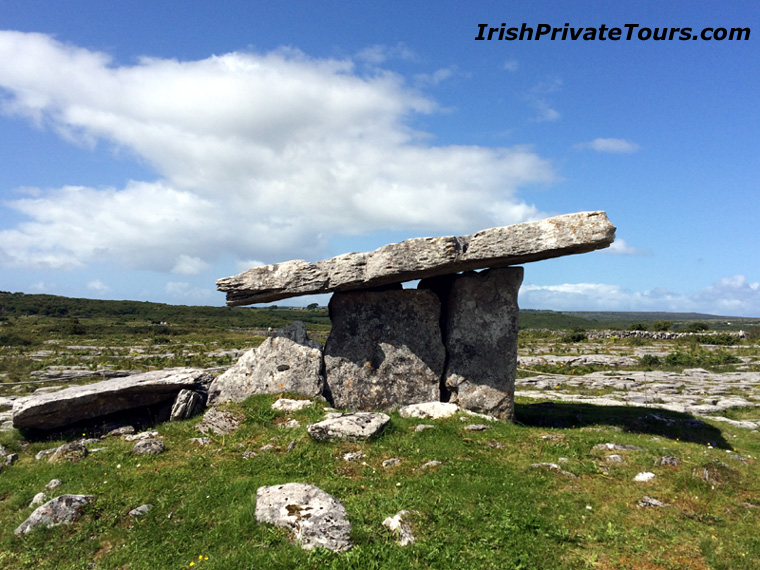 Poulnabrone Dolmen
Poulnabrone Dolmen is a portal tomb in the Burren, County Clare. Some of Ireland's earliest farming communities raised it more than 5,000 years ago. Dr. Ann Lynch excavated the site in the 1980s to conserve a cracked supporting stone.
Her team recovered the remains of at least 36 people. Most belong to the Neolithic use of the tomb, around 3850 to 3100 BC. The total also includes later activity. Finds included a polished stone axe, chert arrowheads, pottery fragments, beads and pins. The dolmen stands on a low rise above the limestone pavement, so it makes a striking landmark.
Suggested Private Burren Day Tour:
- Pick up from your accommodation in the Dublin area.
- The iconic Poulnabrone dolmen (photo above) in the heart of the Burren.
- The Burren Perfumery
- The picturesque coastal village of Doolin
- The world famous Cliffs of Moher with stunning views of the Atlantic Coast.
- A drive along the Galway Bay part of the Wild Atlantic Way.
- Return to your accommodation in Dublin.
Poulnabrone Dolmen
A Neolithic Tomb in the Burren
Poulnabrone Dolmen is one of Ireland's best known prehistoric monuments. It stands above the limestone pavement of the Burren. Ireland's earliest farming communities built this portal tomb more than 5,000 years ago.
Archaeologist Dr. Ann Lynch excavated the monument during the 1980s. Serious cracks had appeared in one of its large supporting stones, and conservation work was urgent because the tomb might otherwise have collapsed. The excavation also produced important new evidence about Neolithic Ireland.
The Beginning of Farming in Ireland
The Neolithic Period, or New Stone Age, began in Ireland around 3900 BC. Farming arrived then, and communities began building large stone monuments for their dead.
Poulnabrone stands on a low rise in the Burren landscape. Its tall portal stones and massive capstone create a striking landmark.
Burials at Poulnabrone
Lynch's 2014 Poulnabrone monograph records a minimum of 36 people, among them 19 adults and 17 children. Most of the Neolithic remains date from around 3850 to 3100 BC, so the community used the tomb as a burial place for perhaps 700 years. The count also includes later activity, including a Bronze Age fetal burial at the entrance. Research by Dr. Rick Schulting suggests the Neolithic burials happened intermittently, with perhaps one person entering the tomb every generation.
How the Dead Were Treated
The remains were mostly incomplete and disarticulated rather than complete skeletons. Some bones show evidence of exposure to heat, suggesting complex practices involving the removal and redeposition of remains.
The excavation also uncovered a polished stone axe, chert arrowheads, pottery fragments, beads and pins.
The People Behind the Bones
One woman buried at Poulnabrone appears to have lived into her late fifties. Her remains provide a rare glimpse of an older member of a Neolithic community. They also raise interesting questions about her place within the group.
There was also evidence of violence. Excavators found the tip of a stone arrowhead embedded in the hip bone of an adult male. The bone showed no signs of healing, so the injury occurred close to the time of his death.
A Glimpse into Neolithic Ireland
Poulnabrone is more than an impressive ancient monument. The discoveries from its excavation reveal something of the people themselves. They lived, died and buried their dead in the Burren more than 5,000 years ago. Their remains provide a rare and very human glimpse into life in Neolithic Ireland.
Further reading
Poulnabrone: An Early Neolithic Portal Tomb in Ireland by Dr. Ann Lynch.
Death in Irish Prehistory by Gabriel Cooney